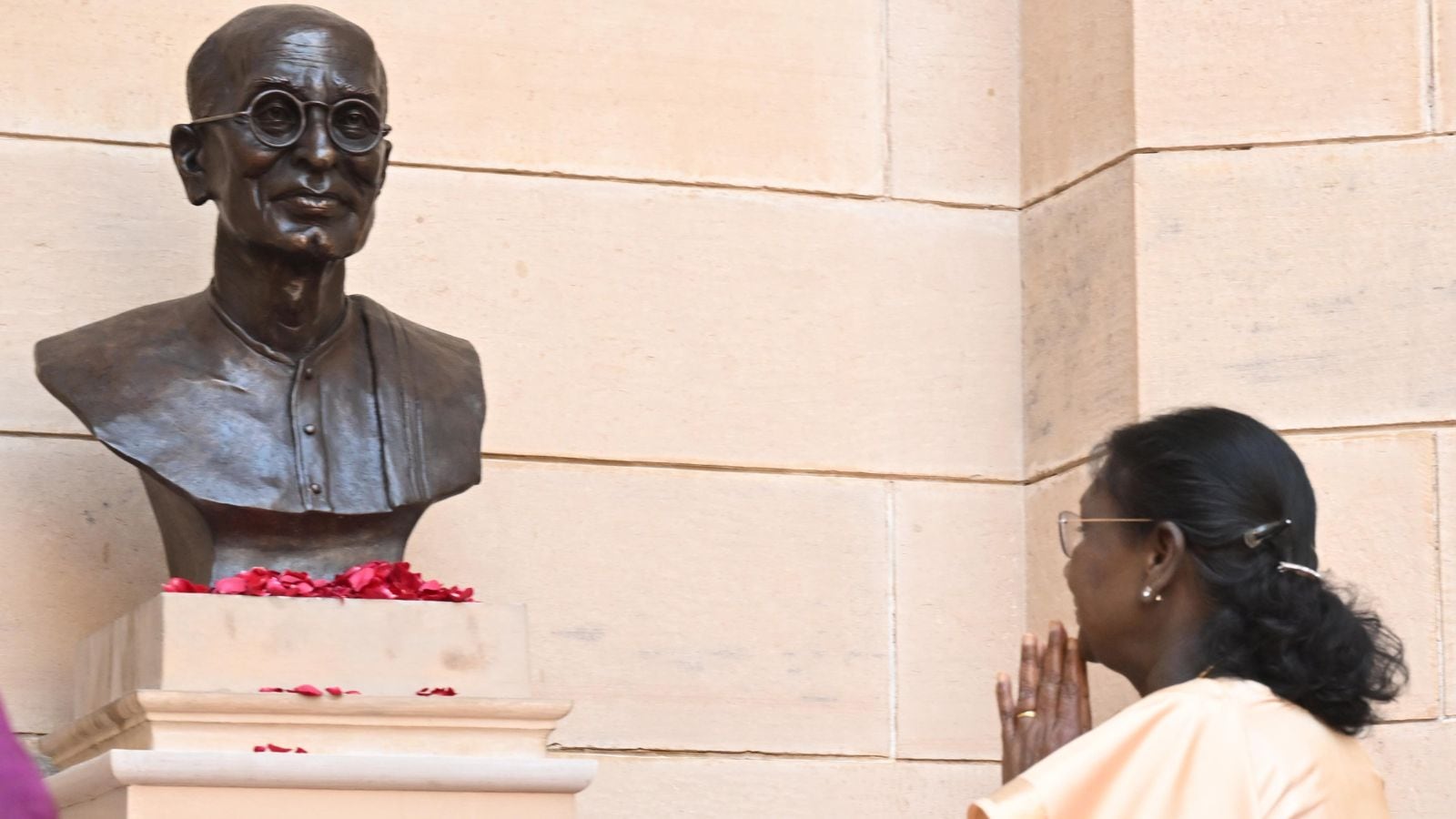
With Prime Minister Narendra Modi on Sunday announcing that a statue of British architect Edwin Landseer Lutyens would be replaced by one of C Rajagopalachari — the first Indian occupant of Rashtrapati Bhavan as the Indian governor general from June 1948 to January 1950 — in a bid to move towards freedom from a “mentality of slavery”, the Centre has framed its decision as part of a “decolonisation” attempt.
The politics of the move is multilayered. The word Lutyens has been synonymous with central Delhi elitism and is often used to denote an upper-class status. It is in Lutyens’ Delhi, as central Delhi is called, that the accommodations of senior government officials are housed.
In terms of optics, the replacement of the statue of Lutyens is also an attack on Anglicised elites in India, a class that the BJP has repeatedly suggested as elitist, having global connections, and being the core of the Left and liberal establishment in India that Modi has purportedly replaced.
The first family of the Congress is projected as a promoter of the Lutyens’ lobby. PM Modi has used the term Lutyens in a pejorative manner in the past.
For instance, in March 2025, he said, in the context of the continuation of colonial-era laws, “I am surprised that the Lutyens Jamaat and the Khan Market Gang have been silent on this for so many years.
The people who are the thekedaar of PIL, those who visit court every now and then, why weren’t they worried about liberty back then.
” Modi had said multiple times last year that India should “put the locks on” the Western mindset embedded in India since 1835 through Thomas Macaulay’s project of reshaping Indian thought by dismantling indigenous knowledge systems and enforcing colonial education.
The move to replace Lutyens with Rajaji also comes before the Tamil Nadu elections, but may have no impact there. Ever since the rise of the Dravidian movement in the state, Rajaji, a Brahmin, has no longer remained a prominent figure in the state.
He has been fully replaced by Periyar, and his return at Rashtrapati Bhavan can also be seen as a move that runs contrary to the Dravidian politics of the state. “In 1937, Rajaji, as Madras Presidency Premier, backed compulsory Hindi in the Madras Presidency, sparking a reaction.
This was at the heart of the first anti-Hindi feeling in the state. Three decades later, in 1967, he turned so much anti-Congress that he campaigned for the DMK.
In Brahmin-heavy localities like Triplicane and Mylapore, he asked Brahmins to hold their sacred thread in the left hand and use the right hand to vote for the DMK,” said former journalist Kalyan Arun, who is now a professor at the Asian College of Journalism in Chennai.
Rajaji, as Chief Minister, introduced a scheme in 1953 that mandated students to spend half their school hours learning the family trade, which was criticised as perpetuating caste-based family occupations, said Arun.
Rajaji had to resign over the row, with the Congress replacing him as CM with K Kamaraj. The scheme was subsequently withdrawn.
Rajaji, a prominent freedom fighter, was in his later years seen as a counter to Jawaharlal Nehru, particularly Nehruvian socialism, when he formed the pro-market Swatantra Party.
Such was his impact in those days that Maharani Gayatri Devi of Jaipur, who joined the Swatantra Party, recalled him at length in her memoirs. “We had heard our friends talk enthusiastically about a new party called the Swatantra (“Independent”) Party.
Now, at last, or so people were saying, there was some hope of effective opposition to the Congress Party, both in the country and in Parliament,” she wrote.
“The leader of the new party was Chakravarty Rajagopalachari, the acknowledged elder statesman of India, who had been one of Mahatma Gandhi’s close associates during the long struggle for Independence and had subsequently been the overwhelming choice to succeed Lord Mountbatten as Governor-General of India,” Gayatri Devi wrote.
“He had broken with the Congress Party the year before, because he felt that Prime Minister Nehru’s acceptance of socialist doctrine was quite out of keeping with the needs of Indians.
” She went on to describe Rajaji: “I had first met him when he was Governor-General and had come to Jaipur on an official visit in 1949.
He was an exceedingly thin, erect old man, dressed in an impeccably white, crisply starched, handspun cotton dhoti and shirt of his native Madras in south India. The eminence of his position and the pomp with which he was surrounded altered his habits not one bit.
Like a true Tamil Brahmin he was a strict vegetarian, never drank alcohol or smoked, went to bed early and rose before daybreak.
” She added, “He had a high bald head, a network of laughter lines around sharply observant eyes and a wide, ironic smile, and he expressed himself in perfectly phrased, elegant English.
He was an intellectual and a fine scholar, and he could capture the imagination of a crowd at a political meeting.
He went to jail for acts of civil disobedience to promote a national cause, yet he spent his spare time making brilliant translations of the great Hindu epics, the Ramayana and the Mahabharata, from Sanskrit into Tamil and into English.
” Born in London in 1869, Edwin Lutyens was a prominent British architect who designed large parts of New Delhi. He was engaged to design prominent buildings of the city in 1912, after the capital was shifted from Kolkata to New Delhi.
This included Rashtrapati Bhavan, India Gate, North Block and South Block. He designed Rashtrapati Bhavan in collaboration with Herbert Baker. He also designed the Cenotaph in London and was knighted in 1918.
Historian Narayani Gupta told The Indian Express that once when some workmen made his portrait that was like a caricature, Lutyens took it to London and got it installed outside his office.
She said the town-planning of the capital of New Delhi was done in classical Roman style, while there were Indian elements in the detail. Two small roads near Minto Bridge were named after Lutyens and Baker.
Vikas Pathak is deputy associate editor with The Indian Express and writes on national politics. He. Read More.